

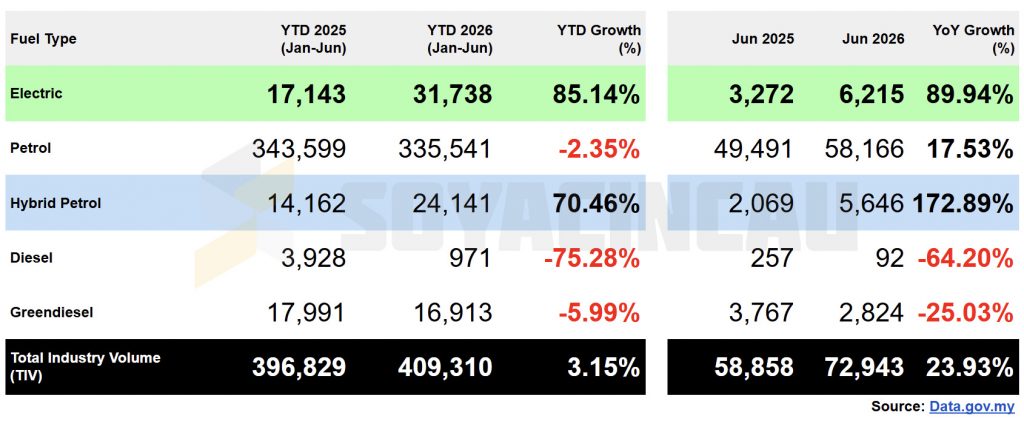
Malaysia’s electric vehicle (EV) market continue to show strong momentum in June 2026, with 6,215 units registered according to the latest JPJ data. That’s an increase of 89.9% compared to 3,272 EVs registered in June 2025.
EVs accounted for 8.52% of Malaysia’s 72,943 total vehicle registrations in June, making it the second-highest monthly EV market share recorded so far this year, behind January’s 9.18%.
For the first half of 2026, Malaysia registered 31,738 EVs. That’s a growth of 85.1% from 17,143 units recorded during the same period last year and is equivalent to 70.8% of the 44,813 EVs registered throughout the whole of 2025.
EV growth continues to outpace the overall automotive market
Malaysia’s automotive market also enjoyed a strong June, with 72,943 new vehicles registered, up 23.9% from 58,858 units recorded in June 2025.
Petrol vehicles remained the largest segment with 58,166 registrations, representing a 17.5% year-on-year increase. Meanwhile, petrol hybrid registrations surged 172.9% to 5,646 units, showing that demand for electrified vehicles continues to grow beyond pure EVs. The most popular hybrid last month is the Proton e.MAS 7 PHEV with 1,138 units, followed by the Toyota Yaris Cross Hybrid with 614 units and the Toyota Corolla Cross Hybrid with 558 units.
Meanwhile, registrations for diesel vehicles fell sharply by 64.2% to 92 units, while Green Diesel vehicles declined by 25.0% year-on-year to 2,824 units.
Looking at the first half of 2026, Malaysia registered 409,310 new vehicles, a 3.2% increase compared to the same period last year.
During the same period, EV registrations jumped 85.1%, while petrol hybrid registrations rose 70.5%, significantly outpacing the overall automotive market.
Top 30 EVs registered in Malaysia for June 2026
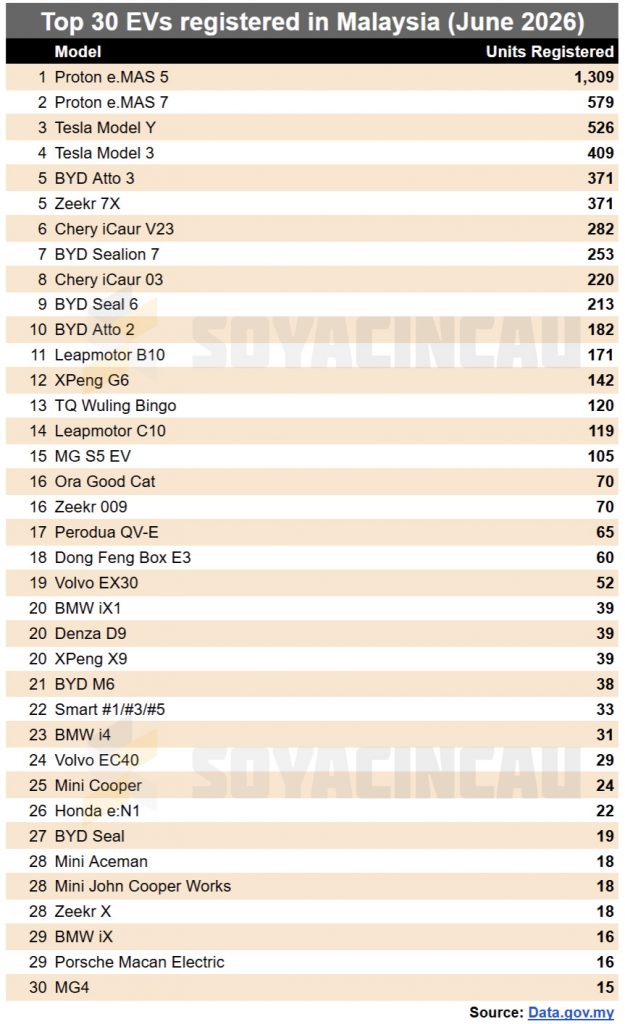
After being overtaken by its larger sibling in May, the Proton e.MAS 5 reclaimed the #1 with 1,309 registrations in June. The Proton e.MAS 7 followed in second place with 579 units, giving Proton a combined 1,888 EV registrations for the month.
Tesla has also made a major come back and recorded strongest month of 2026 so far. The Model Y took the #3 spot with 526 registrations, followed by the Model 3 at #4 with 409 units. Combined, Tesla registered 935 EVs in June, making it the third best-selling EV brand for the month.
Meanwhile, the BYD Atto 3 and Zeekr 7X were tied in fifth place with 371 registrations each.
The Chery iCaur V23 at #6 continued its strong performance with 282 registrations, while the BYD Sealion 7 is at #7 with 253 units.
For those who are wondering, Perodua registered 65 units of its new QV-E in June, which is a slightly decline from 80 units registered in May. The latest figures come after Perodua announced price cuts for the QV-E on 15 June, with the Battery-as-a-Service (BaaS) option reduced from RM80,000 to RM69,999 before rebates.
While the lower pricing was only introduced midway through the month, it will be interesting to see if the more affordable pricing and promotional offers translate into higher registration numbers in the coming months.
Top 30 EVs registered in Malaysia from January to June 2026
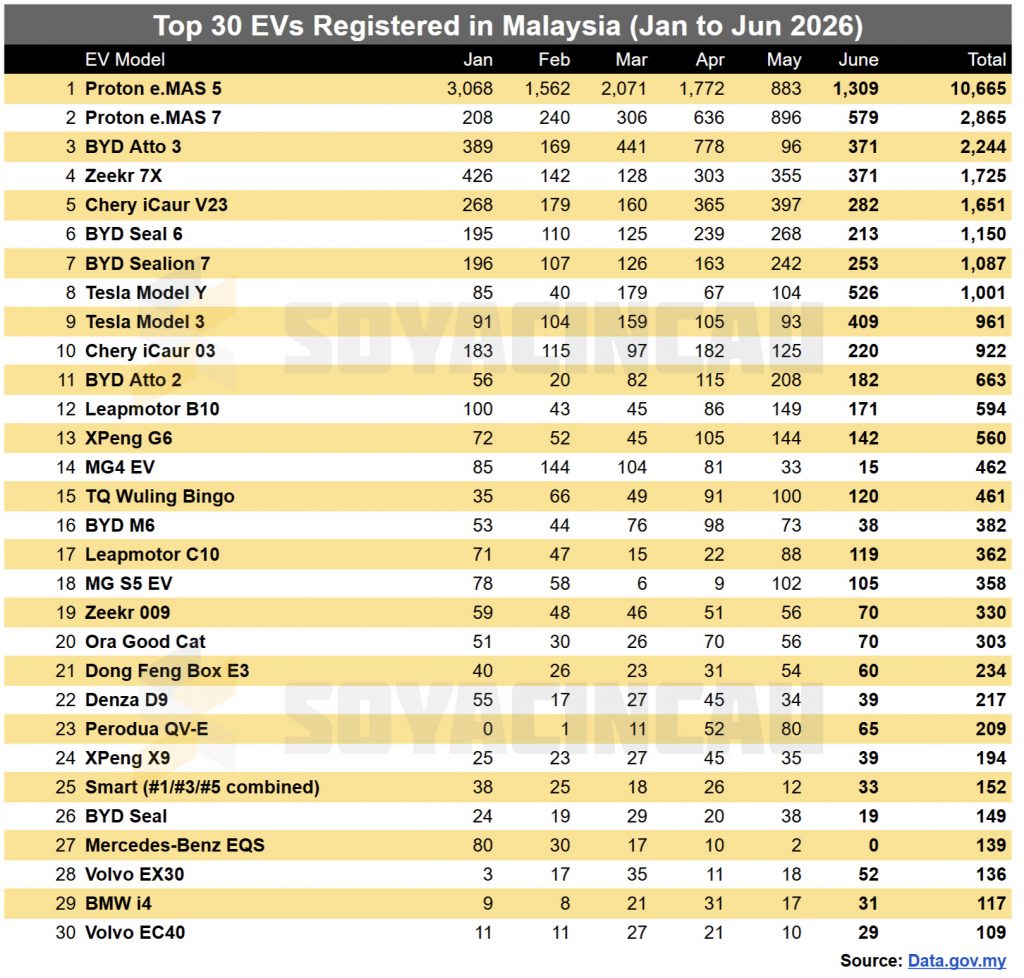
As expected, the Proton e.MAS 5 continues to lead with 10,665 registrations after the first six months of 2026. The Proton e.MAS 7 remained in second place with 2,865 units, while the BYD Atto 3 held on to third with 2,244 registrations.
The Zeekr 7X and Chery iCaur V23 remain among the top five with 1,725 and 1,651 registrations, respectively.
On the brand front, Proton maintained a commanding lead with 13,530 EV registrations year-to-date. BYD remained in second place with 5,675 registrations, followed by Chery (2,649), Zeekr (2,086) and Tesla (1,962).
Top 20 EV Brands in Malaysia from January to June 2026
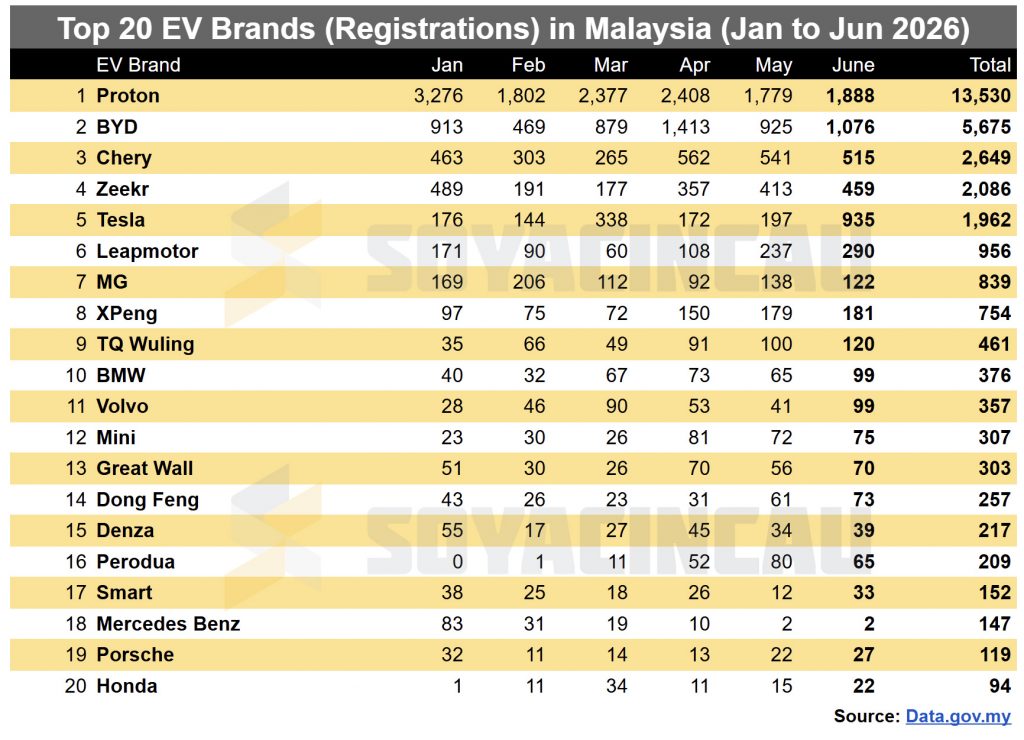
After six months, the Proton e.MAS brand remains a dominant leader in Malaysia’s EV market by a huge margin with 13,530 registrations. That’s equivalent to 43% market share, driven by the strong performance of the e.MAS 5 and e.MAS 7 which undercuts many of its rivals.
BYD retained second place among EV brands with 5,675 registrations, supported by a wide variety of EV options led by the Atto 3, Seal 6 and Sealion 7. Chery climbed to third with 2,649 registrations, driven by the strong demand for its lifestyle-oriented iCaur V23 and iCaur 03 EV SUVs.
This is followed by Zeekr at #4 with 2,086 registrations driven by the Zeekr 7X, while Tesla is at #5 with a total of 1,962 registrations so far.
Policy changes have yet to slow EV momentum
Despite policy challenges such as the expiry of CBU EV tax incentives and the government’s move to restrict the import of affordable fully imported EVs, Malaysia’s EV market has continued to grow strongly.
Looking at the current registrations, there appears to be little immediate impact on the market. In fact, several brands continue to launch new CBU EVs priced below RM200,000 such as the Zeekr X 2026, BYD Atto 3 2026 and the Suzuki eVitara. This suggests that existing inventories are still supporting demand, at least in the near short term.
It will be interesting to see how the market evolves over the coming months as inventories are gradually depleted and manufacturers adjust their product strategies.
At the time of writing, BYD, currently Malaysia’s second-largest EV brand, has yet to provide an update on its CKD plans after its original proposal to establish a CKD facility in Tanjung Malim stalled. However, there are indications that BYD may partner with Sime Motors to assemble its EVs at Inokom’s plant in Kulim.
The industry also needs clarity and long term policies as the current tax incentives for CKD EVs are set to end by 31st December 2027.
Will Malaysia surpass 70,000 EV registrations by the end of the year, or could it even get closer to the 80,000 mark? We’ll have to wait and see whether Malaysia’s local EV assembly capacity can ramp up quickly enough to meet growing demand.