

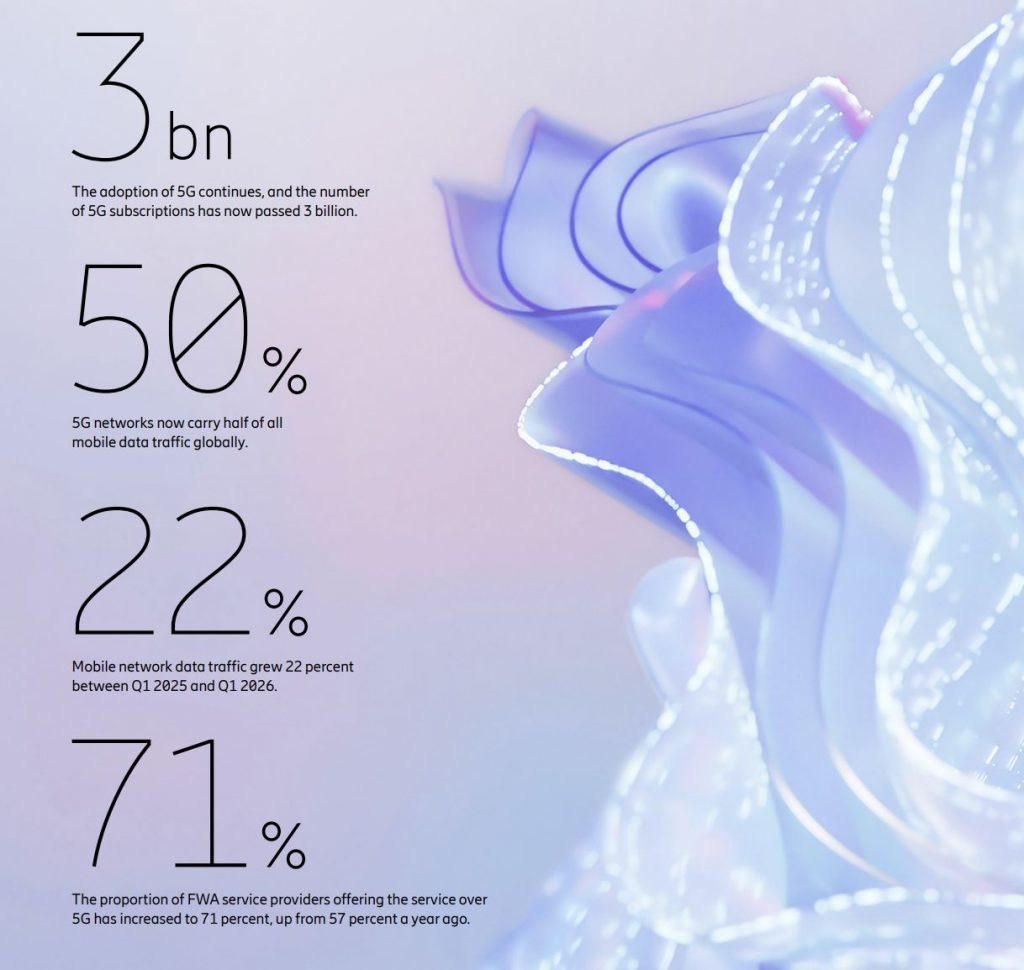
Global 5G subscriptions have surpassed the three billion mark, according to the latest Ericsson Mobility Report.
At the same time, the report highlights how mobile connectivity is becoming an increasingly important foundation for artificial intelligence (AI), with businesses increasingly looking into AI, cloud services and mobile networks to improve efficiency, enhance customer experiences and unlock new growth opportunities.
Ericsson’s report highlighted that many organisations are still at an early stage of scaling AI across their operations, creating opportunities for service providers to support enterprises with secure, reliable and high-performance connectivity.
For Malaysia, Ericsson believes the country’s existing 5G infrastructure provides a strong foundation for AI deployment.
Head of Ericsson Malaysia, Sri Lanka and Bangladesh, David Hagerbro said, “AI will transform how enterprises operate, innovate and serve their customers. But AI needs a strong digital foundation to deliver real impact. Malaysia has that foundation in place through Digital Nasional Berhad’s (DNB) world-class 5G network, which gives enterprises the speed, reliability and security needed to scale AI across their businesses. This puts Malaysia in a strong position to turn AI ambition into real economic value.”
Global 5G subscriptions exceed 3 billion
According to the latest report, global 5G subscriptions exceeded the three billion mark during the first quarter of 2026. A total of 162 million new 5G subscriptions were added during the quarter, bringing the worldwide total to 3.1 billion subscriptions.
Ericsson forecasts that this figure will more than double to 6.4 billion subscriptions by the end of 2031.
The report adds that 390 service providers have launched commercial 5G services globally, with more than 90 operators already offering 5G Standalone (SA) networks.
Ericsson expects 5G networks to carry 85% of global mobile data traffic by 2031, up from 48% at the end of 2025.
Regions including Western Europe, North America, North East Asia and Gulf Cooperation Council (GCC) countries are projected to achieve 5G adoption rates close to or above 90% by the end of 2031.
5G network slicing gains momentum
Ericsson also highlighted growing adoption of differentiated connectivity services enabled by 5G Standalone (5G SA) network slicing.
The report says the number of commercial offerings based on 5G SA network slicing increased from 65 in November 2025 to 84 across all regions in June 2026.
Network slicing allows telcos to prioritise portions of a 5G network with guaranteed quality-of-service levels for specific applications and industries. The growth indicates that services based on differentiated connectivity are moving from early adoption to mainstream commercialisation.
Ericsson CTO and EMR publisher, Erik Ekudden, said “With the upcoming transition to physical AI, traffic patterns will fundamentally shift as we move from centralised models in data centers to distributed, autonomous AI agents embedded across our device vehicles and cities, commonly connected by 5G.”
He added, “Mobile networks are no longer only about providing best-effort connectivity, they are becoming critical, intelligent infrastructure that meets diverse application needs. Reflecting part of this shift is the continued rise in new commercial service offerings based on 5G standalone network slicing and the number of communications service providers deploying 5G SA.”
AI could drive a major increase in uplink traffic
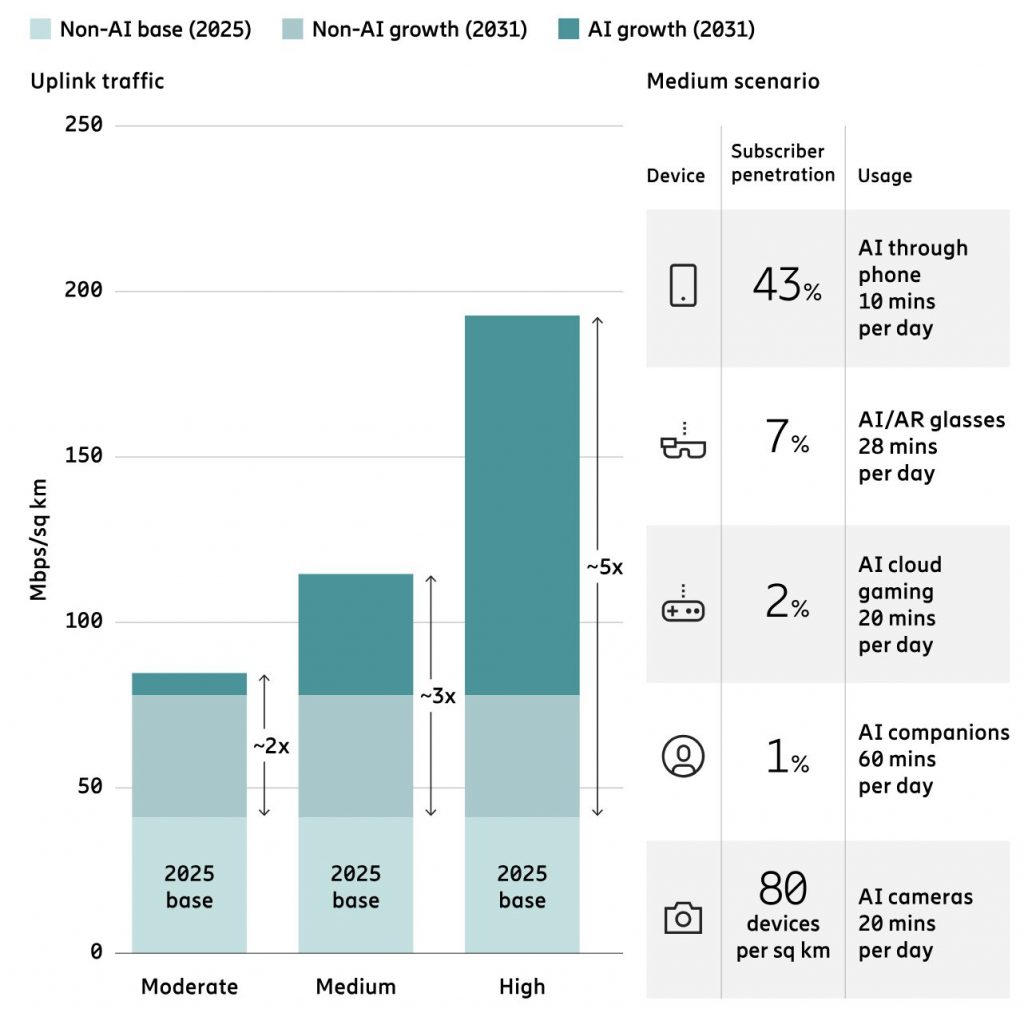
Report also noted the changing nature of mobile data traffic with the rise of AI.
Ericsson says uplink traffic is now growing faster than downlink traffic for most service providers, driven by smartphone communication and collaboration apps, sharing of user-generated content and cloud storage.
Based on Ericsson’s measurements, 43 out of 55 service providers recorded higher uplink growth than downlink, while 17 out of 55 operators saw uplink traffic grow at more than 1.5 times the rate of downlink.
Ericsson’s scenario modeling suggests that additional AI-driven traffic could result in uplink traffic being three times higher or more in 2031 compared to 2025.
While uplink is becoming the new bottleneck in mobile networks, networks designed for downlink dominance must evolve to support a more uplink-intensive future.
Meanwhile, total network data traffic, including mobile and fixed wireless access (FWA), grew 22% year-on-year in the first quarter of 2026, exceeding expectations. This is said to be driven mainly by continued growth in India and North America.